How to Choose the Right UV Printing Machine for Your Business
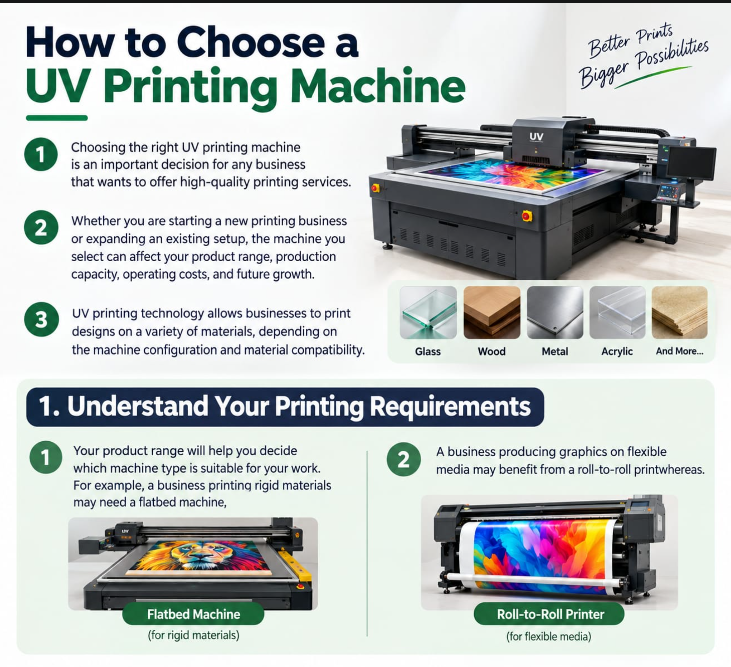
Choosing the right UV printing machine is an important decision for any business that wants to offer high-quality printing services. Whether you are starting a new printing business or expanding an existing setup, the machine you select can affect your product range, production capacity, operating costs, and future growth.
UV printing technology allows businesses to print designs on a variety of materials, depending on the machine configuration and material compatibility. However, every printing business has different requirements. Before investing in a machine, it is useful to understand your printing needs, available space, budget, and expected workload.
In this guide, we will explain the main factors to consider when choosing a UV printing machine for your business.
1. Understand Your Printing Requirements
Understanding how to choose a UV printing machine can help you compare different options and find a model that suits your business needs. The first step is to identify the products you want to print. Some businesses focus on promotional products and customized gifts, while others work with acrylic sheets, decorative panels, labels, stickers, or large-format graphics.
Your product range will help you decide which machine type is suitable for your work. For example, a business printing rigid materials may need a flatbed machine, whereas a business producing graphics on flexible media may benefit from a roll-to-roll printer.
Make a list of the materials you plan to print on, the maximum print size you require, and the number of orders you expect to handle. This will help you compare machines based on practical business needs rather than price alone.
2. Compare Different Types of UV Printing Machines
UV printing machines are available in different formats. Each type is designed for particular production requirements.
UV Flatbed Printing Machine
A UV flatbed printer is designed to print on compatible flat and rigid materials. Depending on the model and configuration, it can be used for products such as acrylic panels, MDF boards, signs, and decorative items.
When comparing flatbed printers, check the working area, material clearance, printhead configuration, and support for the materials you intend to use.
UV Roll-to-Roll Printing Machine
A UV roll-to-roll printer is designed for flexible media supplied in rolls. Depending on the machine, suitable applications may include vinyl graphics, wallpaper, banners, backlit film, and display graphics.
Consider the printing width, media handling system, production speed, and compatibility with your intended materials before making a decision.
UV DTF Printing Machine
UV DTF printing is commonly used to create transferable designs for suitable products and surfaces. It can be useful for businesses offering customized branding, decorative graphics, and personalized products.
Before purchasing a UV DTF machine, review its printing width, ink configuration, film requirements, finishing process, and maintenance needs.
3. Check the Printing Size and Working Area
The printing area determines the maximum size of the design or material a machine can handle. Choosing a suitable working area can help you manage your regular orders more efficiently.
For smaller customized products, a compact machine may be sufficient. If your business handles larger panels or wide-format graphics, you may need a machine with a larger printing area.
Think about both your current workload and your future plans. A machine that is too small may limit the orders you can accept, while a machine that is larger than necessary could increase your initial investment and operating expenses.
4. Understand Printheads and Ink Configuration
Printheads and ink configuration are important factors when comparing UV printers. Different models may support different printheads, colour arrangements, and production capabilities.
Many UV printing setups use CMYK colours, with white ink and varnish available on compatible configurations. White ink can help produce designs on suitable dark or transparent materials, while varnish may be used for selected finishing effects.
The right configuration depends on the products you plan to manufacture. Ask the supplier about print quality, supported inks, replacement costs, cleaning procedures, and the availability of compatible consumables.
5. Set a Realistic Budget
The purchase price is only one part of the total cost of owning a UV printing machine. You should also account for ink, cleaning supplies, maintenance, electricity, software, installation, training, and possible replacement parts.
Compare machines according to their features and suitability for your business rather than choosing the lowest advertised price.
It is also helpful to ask for a detailed quotation that explains what is included in the package. Confirm whether installation, operator training, warranty coverage, and after-sales support are provided, and whether any additional charges apply.
6. Evaluate Installation, Training, and After-Sales Support
A printing machine is a long-term business investment, so support after purchase matters. Proper installation and operator training can help you understand the machine’s functions and routine maintenance requirements.
Before selecting a supplier, ask how technical issues are handled, what warranty terms apply, and whether replacement parts and compatible inks are available.
You should also understand the recommended maintenance schedule and the steps required to keep the printhead and ink system in suitable working condition.
At Rankgo, customers can explore UV printing machine options and discuss their intended applications before choosing a suitable setup. Contact the team to ask about machine specifications, installation, training, and available support
https://search.google.com/search-console/about.
7. Consider Your Future Business Growth
Your printing requirements may change as your business grows. You may begin with a limited range of customized products and later expand into signage, decorative printing, branding, or larger production orders.
Choose a machine that fits your current budget while considering your expected workload and future product plans. Ask the supplier whether the selected configuration can meet your anticipated requirements and what upgrades, if any, may be available.
A practical purchase decision should balance print quality, machine capability, running costs, maintenance, and business demand.
Conclusion
Choosing the right UV printing machine starts with understanding your business requirements. Consider the materials you want to print, the required working area, printhead and ink configuration, total operating costs, and the level of technical support available.
Compare suitable UV flatbed, roll-to-roll, and UV DTF options before making your final decision. Taking time to evaluate these factors can help you select a machine that fits your production needs and business goals.
If you are exploring UV printing solutions, visit Rankgo’s Products page to review available machine options, or contact the team to discuss your requirements and request further information. Knowing how to choose a UV printing machine involves comparing your printing needs, budget, machine configuration, and after-sales support.https://project.rankgo.in/
