UV Printing Machine Applications, Benefits and Business Opportunities
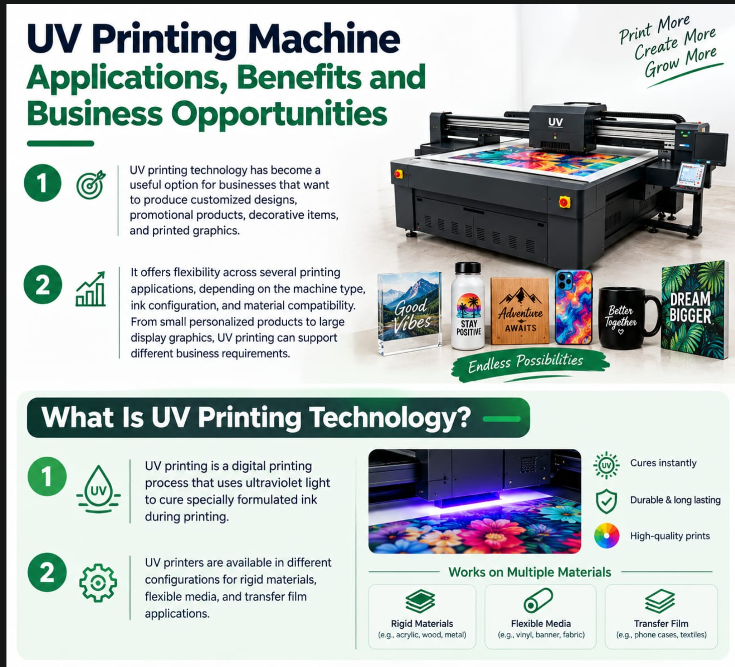
UV printing technology has become a useful option for businesses that want to produce customized designs, promotional products, decorative items, and printed graphics. It offers flexibility across several printing applications, depending on the machine type, ink configuration, and material compatibility. From small personalized products to larger display graphics, UV printing can support different business requirements.
For entrepreneurs planning to enter the printing industry, understanding UV printing machine applications is an important first step. It helps them identify suitable products, understand customer demand, and decide which printing equipment may fit their business goals.
In this guide, we will explore common UV printing applications, the benefits of the technology, and the factors businesses should consider before investing in a machine.
1. What Is UV Printing Technology?
UV printing is a digital printing process that uses ultraviolet light to cure specially formulated ink during printing. The curing process helps the ink form a printed layer on compatible materials.
Unlike printing methods that depend on ink drying through evaporation alone, UV printing uses UV light as part of the curing process. The resulting print performance depends on the machine, ink, surface, and operating conditions.
UV printers are available in different configurations for rigid materials, flexible media, and transfer-film applications. Selecting the right configuration is important because not every machine is designed for every material or product.
2. Common UV Printing Machine Applications
UV printing can support a wide range of applications. The most suitable machine depends on the size, shape, surface, and quantity of the products being printed.
Printing on Acrylic and Rigid Materials
UV flatbed printers can be used for printing on compatible rigid materials such as acrylic sheets, MDF boards, and selected decorative panels. These applications are useful for businesses producing signs, display panels, interior décor items, and customized boards.
Before printing, the material should be checked for compatibility with the ink and machine. Surface preparation and suitable printing settings can also affect the final result.
Customized Gifts and Promotional Products
Businesses may use suitable UV printing systems to create personalized products, branded merchandise, and promotional items. Depending on the equipment and product surface, applications can include customized accessories, nameplates, and selected gift products.
Personalization can help businesses serve customers looking for distinctive designs for events, gifts, and corporate branding. However, product shape and surface access must be considered before selecting the printing method.
Labels, Stickers, and Transfer Graphics
Certain UV printing setups can support label graphics or transfer-based decoration. UV DTF systems, for example, are commonly used to create designs that can be transferred to suitable surfaces using the required film and application process.
Businesses considering this category should understand the complete workflow, including printing, film handling, transfer application, and finishing. Compatibility and durability should be checked for the intended product and use.
Banners, Vinyl, and Display Graphics
UV roll-to-roll printers are designed for suitable flexible media supplied in rolls. Depending on the machine, they may be used for vinyl graphics, wallpaper, backlit film, exhibition displays, and selected banner applications.
For these jobs, businesses should compare printing width, media handling, output quality, and production requirements. Choosing an appropriate machine can help them manage the sizes and quantities commonly requested by their customers.
Decorative and Interior Printing
Printed decorative panels and selected interior graphics can offer opportunities for businesses serving offices, retail spaces, homes, and commercial interiors. UV printing may be suitable for certain decorative materials when the machine and ink are compatible with the surface.
Sample testing is helpful when working with unfamiliar substrates. It allows a business to assess adhesion, appearance, and suitability before accepting larger orders.
3. Key Benefits of UV Printing
UV printing offers several potential benefits, although the results depend on the machine configuration, materials, ink, and application.
Versatility Across Suitable Materials
Different UV printer types can support different materials and production formats. This allows businesses to explore multiple product categories when they select equipment that matches their requirements.
However, material versatility should never be assumed for every printer. Always confirm compatibility with the supplier and test new substrates before production.
Support for Customized Designs
Digital printing makes it possible to produce different designs without creating a separate traditional printing plate for each artwork. This can be useful for personalized products, short runs, and jobs with varying artwork.
The suitability of a particular job still depends on setup time, design complexity, print area, and production volume.
UV Ink Curing During Printing
UV lamps or compatible UV curing systems harden the ink as part of the printing process. This can support efficient handling in suitable workflows, though additional handling or finishing time may still be necessary depending on the product.
Opportunities to Expand Product Offerings
A printing business may be able to serve different customer groups by offering suitable signage, promotional products, decorative prints, or transfer graphics. The right combination depends on local demand, equipment capabilities, available space, and investment.
Instead of trying to offer every service at once, businesses can begin with a clear product category and expand as they gain experience.
4. How to Identify Business Opportunities
Before investing in a UV printer, research the customers you want to serve. Possible customer groups include sign makers, advertising agencies, gift shops, interior designers, product brands, and businesses requiring customized promotional materials.
Talk to potential customers and learn which products they order regularly, what quantities they need, and what quality standards they expect. This information can help you choose an appropriate printing format and estimate the likely demand for your services.
It is also important to calculate costs carefully. Include the machine purchase price, inks, cleaning materials, maintenance, electricity, workspace, software, labour, and marketing. Your pricing should account for these expenses as well as the time needed to prepare and complete each order.
A business opportunity is most useful when it matches customer demand with a realistic production plan.
5. How to Choose a Suitable Machine for Your Application
Start by listing the products you plan to print and the materials used to make them. Then compare machine types, working area, printing width, supported inks, printhead configuration, software requirements, and maintenance needs.
A UV flatbed printer may suit businesses focused on compatible rigid products. A roll-to-roll printer may be more appropriate for flexible media, while a UV DTF system may fit certain transfer-decoration workflows.
Do not select a machine based on specifications alone. Ask for sample prints, confirm the machine’s intended applications, and review installation, training, warranty conditions, and technical support. A clear understanding of the complete production process can help you make a more informed investment.
6. Why Maintenance and Technical Support Matter
Regular maintenance is an important part of operating a UV printing machine. Cleaning routines, correct ink handling, environmental conditions, and following the manufacturer’s instructions can help keep the equipment in suitable working condition.
Operators should learn the recommended maintenance schedule and know how to respond to common issues. The availability of compatible consumables, replacement parts, and technical assistance should also be considered when comparing suppliers.
Training can help a new operator understand machine settings, material handling, print preparation, and routine care. These practical skills are valuable when a business begins accepting customer orders.
Conclusion
UV printing machine applications cover several potential product categories, including compatible rigid panels, customized products, labels and transfer graphics, flexible-media printing, and decorative graphics. The right application depends on the machine type, substrate compatibility, production requirements, and customer demand.
For businesses considering UV printing, the best starting point is to research the market, identify a clear product category, calculate operating costs, and compare suitable machines before investing.
Rankgo helps customers explore UV printing machine options according to their intended applications. Visit the Products page to review available options, or contact the Rankgo team to discuss machine specifications, installation, training, and support for your business requirements. https://project.rankgo.in/
