RankGo Printing Insights
Technical analyses, production guides, and material engineering perspectives on industrial UV flatbed, roll-to-roll, and UV DTF printing solutions.
 Technology & Fundamentals
What Is UV Printing? A Complete Guide to Its Uses, Benefits and Applications
Discover how ultraviolet photopolymerization cures high-density pigment inks on contact, bypassing conventional drying cycles and enabling scratch-resistant commercial production across rigid and flexible media.
 Substrates & Materials
UV Printing on Different Materials: Acrylic, Wood, Glass, Metal and More
An engineering-focused review of substrate surface energies, primers, and curing parameters for applying photocurable inks reliably to acrylic, glass, timber, aluminum, and flexible banners.
What Is UV Printing? A Complete Guide to Its Uses, Benefits and Applications
1. Defining Industrial UV Printing
Ultraviolet (UV) printing represents one of the most transformative developments in digital inkjet reproduction. At its core, UV printing is a non-impact digital deposition process that replaces conventional solvent- or water-based inks with photocurable chemical compounds. Instead of waiting for liquid carriers to evaporate into the atmosphere or absorb into the pore matrix of paper, UV systems instantly convert liquid ink into an inert, solidified polymer matrix through an artificial photochemical reaction.
This capability decouples digital imaging from the traditional necessity of coated, highly absorbent papers. By using high-precision drop-on-demand piezoelectric printheads, commercial UV printers deposit micro-droplets of ink onto virtually any substrate—rigid panels, flexible films, leather, or synthetic polymers—and solidify them in fractions of a second. This makes UV printing services fundamental to modern industrial signage, point-of-sale branding, electronic personalization, and specialty product decoration.
2. How the UV Printing Process Works
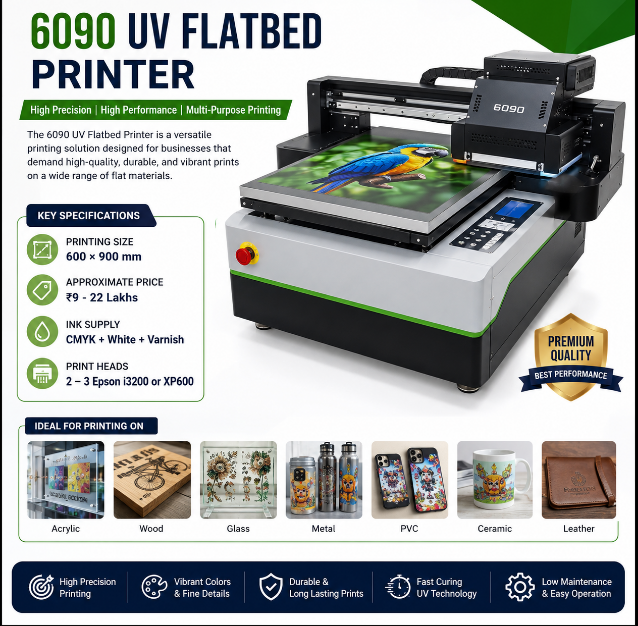
The production cycle of an industrial UV printing platform operates through three synchronized stages: mechanical feeding, piezoelectric droplet ejection, and localized ultraviolet radiation exposure.
First, the substrate is positioned on either a flat, multi-zone vacuum suction table (for rigid sheets) or mounted across dynamic tension rollers (for continuous roll-fed media). The vacuum bed prevents shifting or thermal deformation during the sweep of the heavy print carriage. The operator imports vector graphics or raster files into specialized Raster Image Processor (RIP) software, which translates graphic art into color channels, resolution matrices, droplet sizes, and carriage pass speeds.
Second, as the printhead carriage travels across the substrate along high-precision linear guide rails, microscopic piezoelectric crystals inside each nozzle channel flex in response to electronic pulses. This microscopic physical contraction expels calibrated picoliter volumes of liquid ink through hundreds of miniature nozzle apertures onto the material with spatial tolerances down to fractions of a millimeter.
Third, trailing immediately behind the printhead array are compact, high-output ultraviolet light sources (typically cold UV Light Emitting Diodes or UV LEDs